The STEM Fair
The Sacramento Regional STEM Fair is a science, technology, engineering, and math competition for students in grades 5-12 across three divisions: high school (grades 9-12), middle school (grades 6-8), and our non-competitive showcase division open to students in grades 5-11. We are affiliated with the Regeneron International Science and Engineering Fair (ISEF) and the California State Science and Engineering Fair (CSEF).
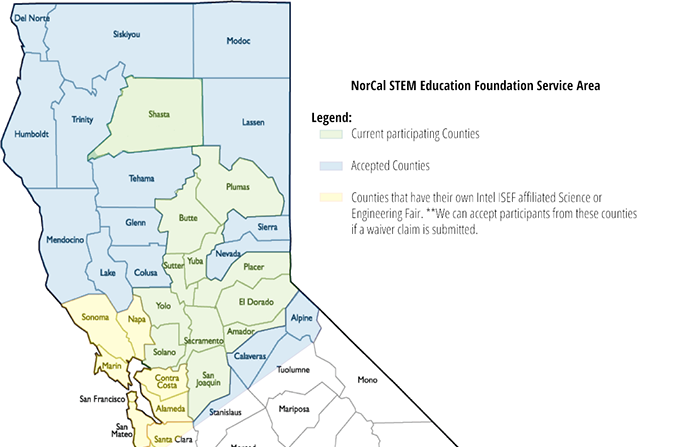
To participate in our competitive divisions, students must be in grades 6-12 and less than 20 years of age on May 1, 2027. They must also: 1) Attend a “brick-and-mortar” public, private, or home school in one of the following counties OR 2) be enrolled full-time in an online middle or high school program AND reside in one of the following counties: Amador, Butte, El Dorado, Placer, Plumas, Sacramento, San Joaquin, Shasta, Solano, Sutter, Yolo, or Yuba.
Projects from outside counties are accepted only if a Regeneron ISEF-affiliated fair is not available in their county. To find other California Fairs, click here. County school/residency requirements will be strictly enforced. Missing a deadline in your home/school county does not create eligibility for the Sacramento Regional STEM Fair. No exceptions will be made.
CSEF Eligibility: Only students competing from the following counties as designated by CSEF are eligible to qualify for the California State Science Fair from the Sacramento Regional STEM Fair: Amador, El Dorado, Placer, Plumas, Sacramento, Shasta, Sutter, Yolo, or Yuba. Students from Butte, San Joaquin, or Solano Counties cannot qualify for CSEF via our Fair.
Scientific Process Categories
Behavioral & Social Sciences
The science or study of the thought processes and behavior of humans and other animals and their interactions with the environment studied through observational and experimental methods.
Chemistry
(Includes Biochemistry, Chemistry, Chemical Energy, and Pharmacology)
Studies that explore the identification of the substances of which matter is composed; the investigation of their properties, and the ways in which they interact, combine, and change, and the use of these processes to form new substances.
Biology & Health Sciences
(Includes Animal, Cellular, and Molecular Biology, Microbiology, Plant Sciences, Health Sciences, and Transitional Medical Sciences)
Focuses on human or animal body systems or overall health.
Physical Sciences & Math
(Includes Earth & Environmental Sciences, Mathematics, and Physics, and Astronomy)
Focuses on the science of matter, energy, mathematical functions, and applied mathematics.
Engineering Design Process Categories
Applied Engineering
(Includes Engineering mechanics, Materials Science, Robotics and Intelligent Machines)
Studies that focus on engineering that involves movement or structure. The movement can be by the apparatus or the movement can affect the apparatus.
Sustainable Technology
(Includes Biomedical Engineering, Physical Energy, Environmental Engineering, and Green Chemistry)
Focuses on sustainable or green materials or products.
Computer Software & Technology
(Includes Computational Biology and Bioinformatics, Embedded Systems and Systems Software)
The practical approach to computation and its applications.